It had been over half a year since my last visit to Shanghai, and Rambu — Chef Jun's newly opened Southeast Asian restaurant — was one of the meals I'd been looking forward to most on this trip.
As a child, I wasn’t a huge fan of Southeast Asian food. The fish sauce, coconut and lemongrass were too overpowering for me, and the relentless layering of sweet, sour, salty and spicy left me completely at a loss. But taste indeed is something that evolves with time and experience. A transcendent bowl of Vietnamese pho in Paris and the punchy beef rendang in Singapore had completely changed my palate 180 degrees. I became a fan of the bold, spice-driven cuisines of Southeast Asia, the Middle East and India. Plus, having tried Chef Jun's cooking at Sage Gastro (now closed), Rambu had been on my radar for a long time.
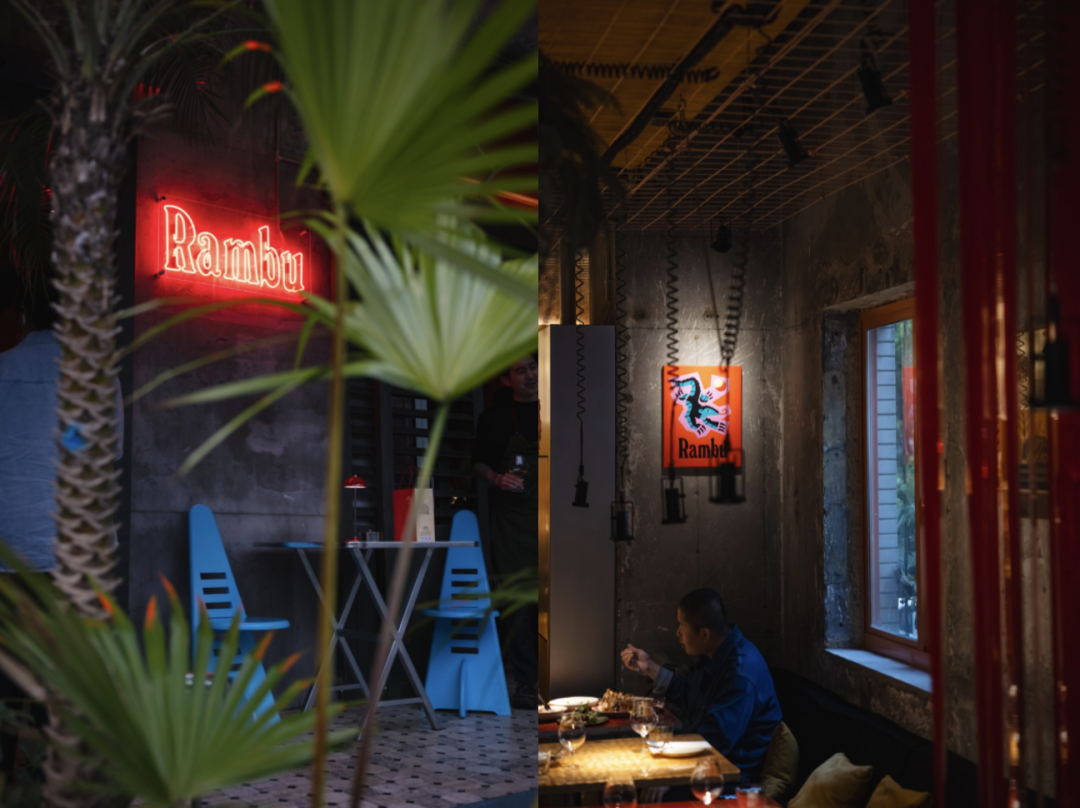
Rambu announces itself with confidence from the street. The glowing red neon sign, warm-toned façade and architectural motifs drawn from Southeast Asian street-front typologies feel as though a pocket of tropical street life has been quietly transplanted to Shanghai's street scene.
Chef Jun came out to greet us in a black Rambu-logo tee. Inside, blocks of sky blue, pandan green and mustard yellow give the space an unmistakably Peranakan energy — bold, saturated, unapologetic — that immediately brought to mind the vivid, maximalist colour palette of Spanish filmmaker Pedro Almodóvar. (I later discovered that one of the founders of Skynoa, Rambu's interior design studio, is indeed Spanish. Perhaps it’s a coincidence? )
Dinner started with a tamarind rasam — warming, peppery and deeply aromatic. The green papaya salad departed from the Thai tradition of adding raw seafood, opting instead for Asian pear, cashews and wild herbs, leaning into the clean sweetness and crunch of fresh vegetables. Both dishes were bright with acidity — a perfect, appetite-sharpening start.
Then came the beef "Tatare-ki" — a playful mashup of tataki and tartare, the name alone a small delight. Inspired by Thai larb, the lightly seared beef was paired with tom yum mayonnaise and crispy rice for textural contrast. I particularly loved the lift from the cherry tomatoes and the fragrance of fresh basil. A second starter of cured amberjack was equally well-executed — rich, yet rendered surprisingly fresh by green chilli, grapefruit and coconut milk.
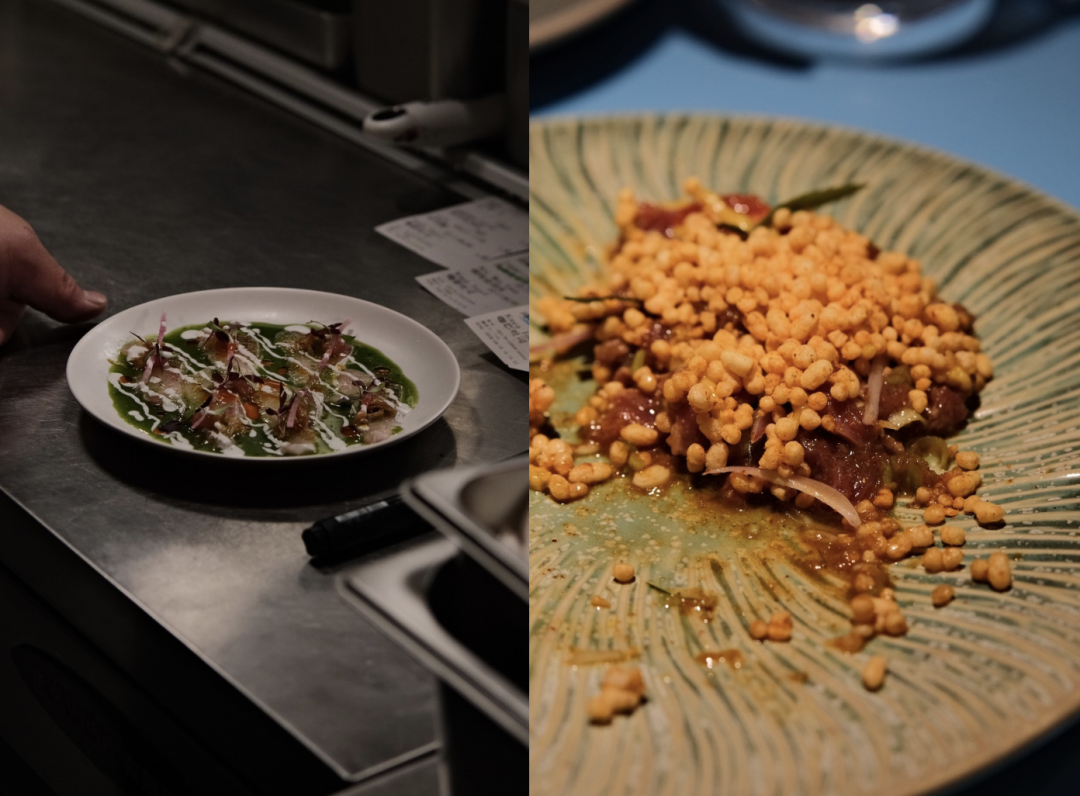 Beef「Tatare-ki」 / Cured Amberjack
Then came what appeared to be a chocolate-filled doughnut — and for a moment I thought we'd skipped straight to dessert. Chef Jun smiled knowingly and revealed it was the Rendang Oxtail Doughnut. At the word "rendang," my eyes lit up immediately. Two years ago, on my first trip to Singapore, my last meal was rendang nasi lemak at The Coconut Club — beef slow-braised in coconut milk and aromatics until dark brown, the spiced perfume long-lingering. It’s been something I still think about even till now. The origins of rendang may remain disputed, but its place on the Southeast Asian table is beyond question. Here, the filling is gelatinous oxtail with infused flavors of coconut, lemongrass, galangal and cinnamon, all wrapped in a pillowy, golden-fried brioche. Honestly, it’s more irresistible than any chocolate doughnut. And the "chocolate" on top? Turned out to be a manis and Guinness glaze that added a gentle note of malt to the doughnut.
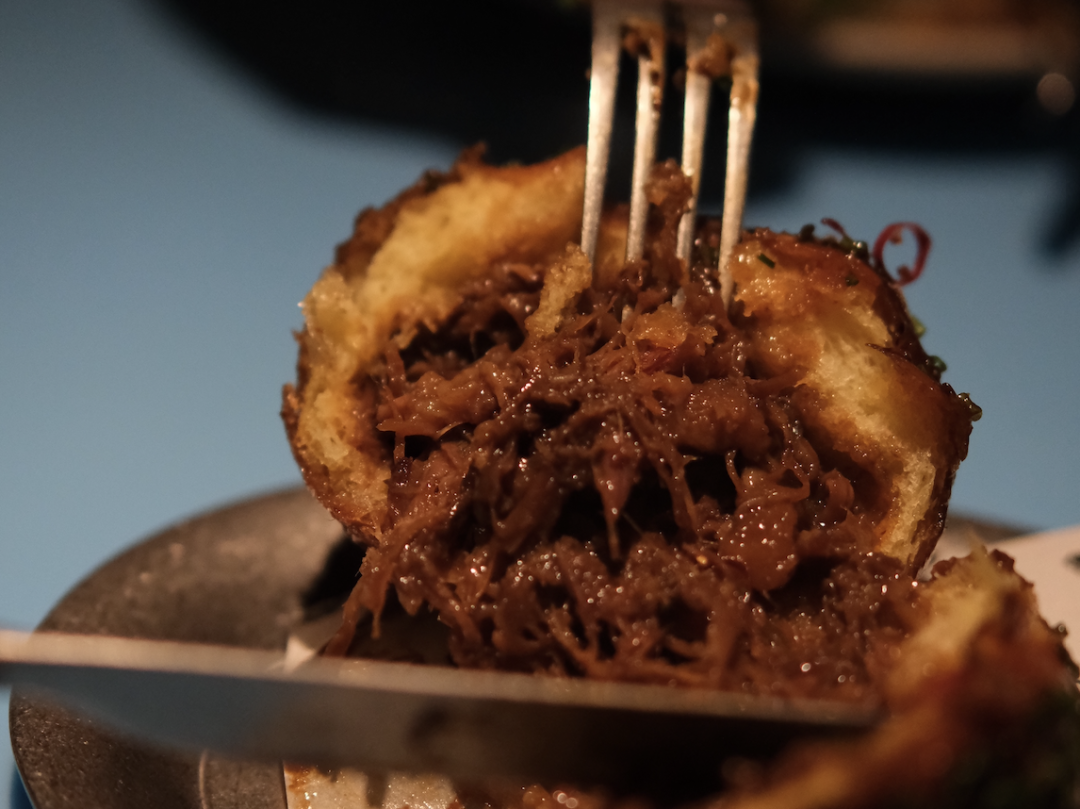 Rendang Oxtail Doughnut
Nasi Ulam was one of Rambu's signatures, and one of the most memorable dishes that evening. Ulam in Malay refers to fresh herbs and greens, so nasi ulam translates simply as "herb rice salad" — though that description does little justice to what arrives at the table: a vivid tangle of red and green, visually exuberant. Slender, fluffy basmati rice is tossed with ginger torch flower, lemon basil, mint, crispy chicken skin, salted fish floss and fried shallots. Already deeply flavourful when fully mixed, the real revelation is the two house-made sambals. The green sambal — built on galangal, blue ginger and green chilli — is punchy and fiercely spiced, reminiscent at first glance of Cantonese crispy shallot sauce; the red sambal is almost like a chilli jam balanced in sweetness and heat. As someone who loves spice and acidity, I love enjoying it with a squeeze of lime and a generous spoonful of each sambal. Acid, salt and sweetness in endless accumulation, the spice deepening with every bite — paired with the crunch of chicken skin and the savouriness of fish floss, this was the flavour bomb of the meal.
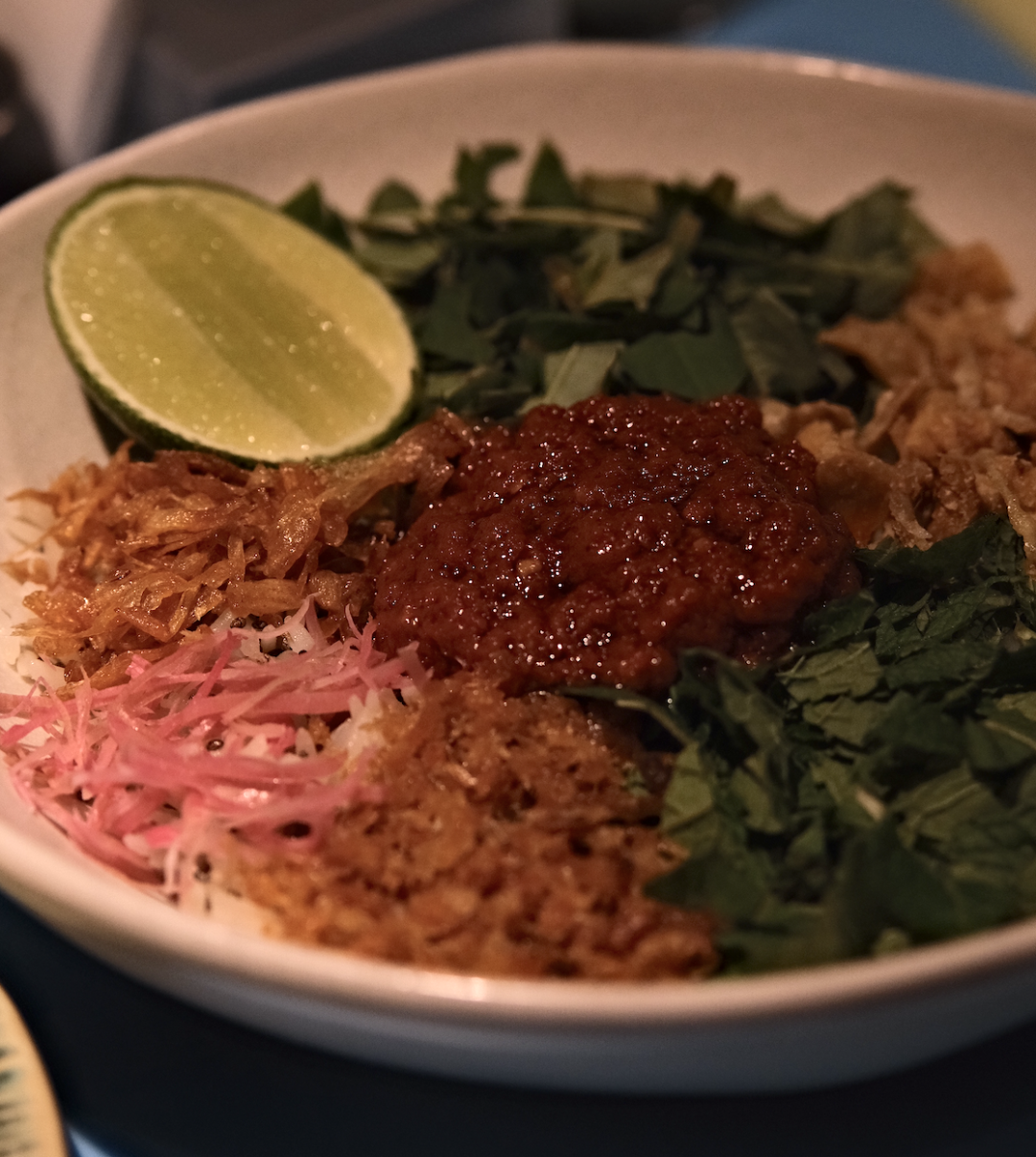 Nasi Ulam
Sambal can be seen as the soul of Southeast Asian cooking. Just like every family having their own recipe for beef noodle soup in Taiwan, sambal exists in infinite variation — yet it never fails to win over anyone who truly loves to eat. I first came across it while I was watching MasterChef Australia, where a Singaporean-born contestant of indian descent named Sashi consistently won over the judges with his sambal, no matter how technically ambitious his competitors got. (And he actually won the competition in the end.) Since then, I've been curious about how magical sambal can be. One thing is certain: at Rambu, the nasi ulam would be incomplete without Chef Jun's sambal.
With more than ten of us at the table that evening, I was fortunate enough to work through nearly the entire menu. Lamb skewers wrapped with betel leaves, grilled pork jowl with spiced relish and brown butter, grilled ox tongue in sourdough dashi with toasted rice powder, whole grilled turbot with sambal butter...... each dish grounded in Southeast Asian flavour, threaded with Japanese and Nordic influences and the unmistakable imprint of Chef Jun's own sensibility. I had expected a cumulative spice fatigue to set in. It never did. The combinations kept surprising me, and I kept reaching for more.
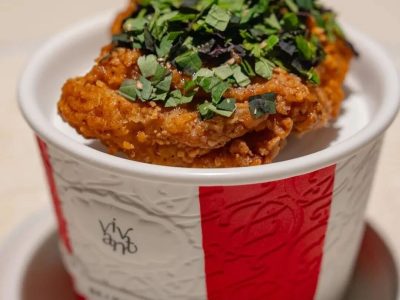
Chef Jun's signature at Sage Gastro was the Thrice Fried Chicken, while Rambu's version riffs on a Thai KFC limited release — "Wingz Zabb" — with zabb roughly translating to "struck by lightning": the sensation of sour, spicy, fresh and fragrant detonating simultaneously on the palate. The chicken is fried then tossed in zabb powder and finished with chilli oil, finished with green mango salad on top. The result? Simply indulgent. Crispy, sweet and sour, then tempered by stracciatella beneath — Indeed a lightning bolt on the palate.
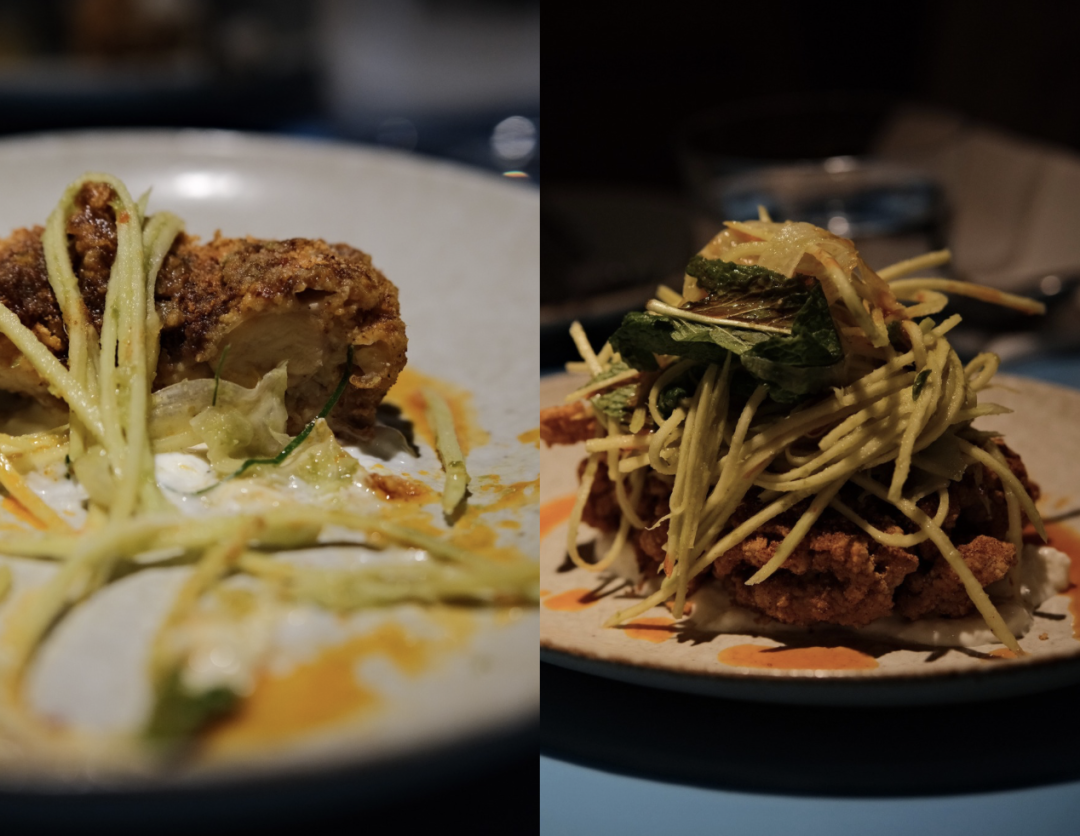 Zabb Zabb Fried Chicken
Speaking of Chef Jun's hometown Singapore, the national breakfast, kaya toast, might come up to your mind straight away. Seeing it reimagined as a dessert was, however, a first for me.
I'm actually not a toast person. I definitely prefer a crusty yet chewy baguette. But I immediately surrendered when I smelled the warm, buttery kaya toast. The amber kaya jam, made from eggs, coconut milk and sugar, was layered with a thick slice of cold butter inside warm, crisp-edged toast. The rounded coconut flavour plus the custardy kaya jam with its gentle, macadamia-like nuttiness, brought back an unexpected memory of the sweet butter toast I loved at Taipei breakfast vendors as a child. Dipped into the savory egg cream on the side that resembled the taste of toffee, it suddenly reached another level. Hot and cold, sweet and savory, not unlike a Hong Kong pineapple bun but with a distinctly tropical soul. I kept feeling a touch of coffee on the finish, and turned out that Chef Jun actually did add a small amount of coffee to the kaya to reduce the eggy undertone — a trick that reminded me of a discovery made last year at Ai due Platani in Parma, where the chef also shared the same “secret” when he was making his celebrated zabaione for the same reason.
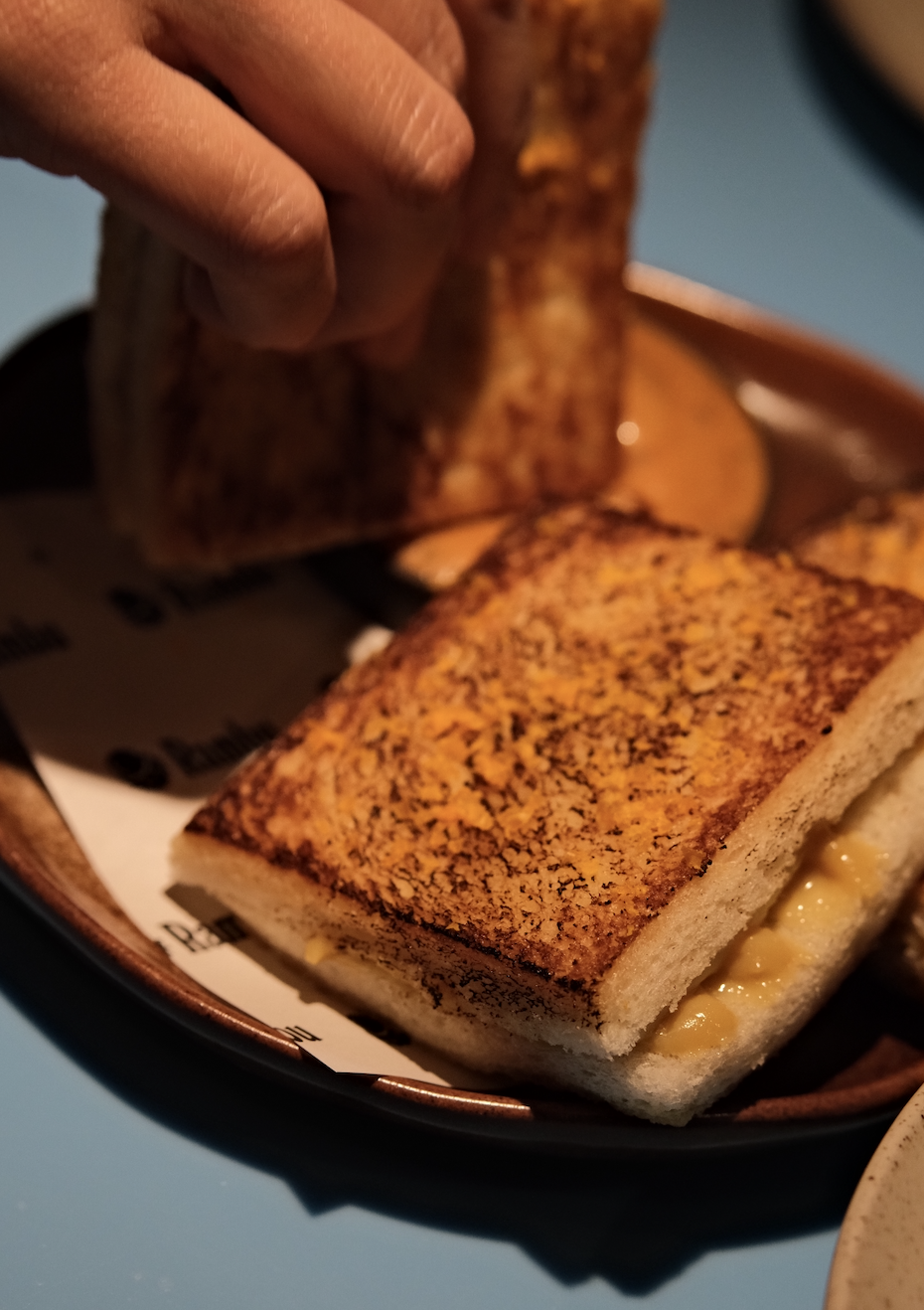 Kaya Toast
What a mind-blowing dessert (literally). I had to restrain myself from reaching for a second slice. If Rambu opens for breakfast, they might see me dropping by way too often.
The name of the restaurant, “Rambu” comes from rambutan, the tropical fruit native to Southeast Asia, and also means “lighthouse” in Indonesian. Chef Jun carries both Singaporean and Japanese heritage, and a career that has taken him through Tippling Club in Singapore, three-Michelin-starred Geranium in Copenhagen, and three-star Ultraviolet by Paul Pairet in Shanghai (now-closed). A chef's food is said to be a reflection of their life — and "diverse" and "borderless" were the exact impressions Chef Jun left on me when I first encountered his cooking at Sage Gastro. Now, with Rambu, he has returned to his roots — weaving together the flavours of his childhood, the breadth of his multicultural journey, and a modern perspective to reinterpret Southeast Asian food culture on his own terms.
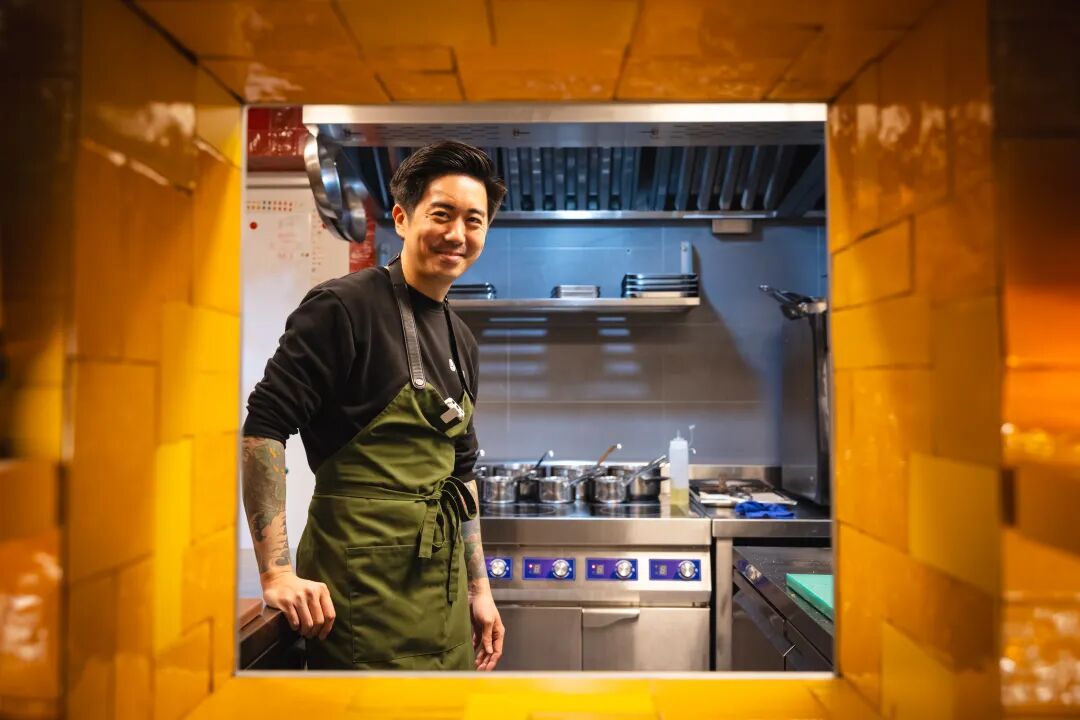 Rambu's Chef & Founder Jun Nishiyama
Last year, it was sad to hear that Sage Gastro was closing, but I was also looking forward to what would come next. Now at Rambu, I found Chef Jun cooking more freely. Anchored in his origins, his cooking feels more alive here — more direct, more spirited, retaining all the vibrancy and unrestrained energy that makes Southeast Asian food so irresistible.
For Rambu alone, I'm already counting the days until my next trip to Shanghai.
Author: Patty Chuang
Image: Patty Chuang/Ye Shi