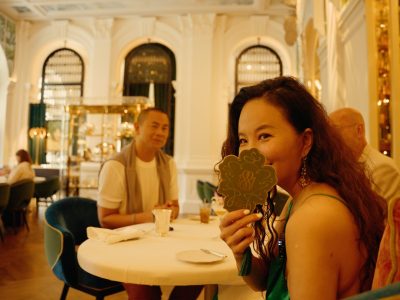
I had the opportunity this time, invited by City of Dreams, to attend the collaboration dinner between Jade Dragon and Chao Shang Chao. Jade Dragon, eight consecutive years of three Michelin stars, three Black Pearl diamonds, the only Cantonese restaurant in Greater China holding both top ratings at once.
Chef Kelvin Au Yeung has been with the Jade Dragon since opening day, working his way up from senior deputy head chef to culinary director. Over thirty years in Cantonese cuisine has given him an exacting eye for ingredients. This year he won Harper's BAZAAR Taste Elite's Chef of the Year for Macau. But what struck me more was who he chose to collaborate with.
Chao Shang Chao in Beijing has held three Michelin stars from 2024 through 2026 — the only three-star Teochew restaurant in the world. That line alone is enough to pique curiosity. Teochew cuisine has never been a minor player on the Greater China food map, but it sat outside the Michelin spotlight until Chao Shang Chao came along.
Chef Cheung Yat Fung is from Hong Kong. After earning two stars at the Crystal Jade Restaurant in Shanghai, he moved to Beijing in 2020 to lead Chao Shang Chao, and took it to three stars in under three years. In 2026, he became the first-ever recipient of the Michelin Guide's Mentor Chef Award in Mainland of China. A Hong Konger, making Teochew food, in Beijing, ending up the only one in the world doing it — the combination alone is interesting.
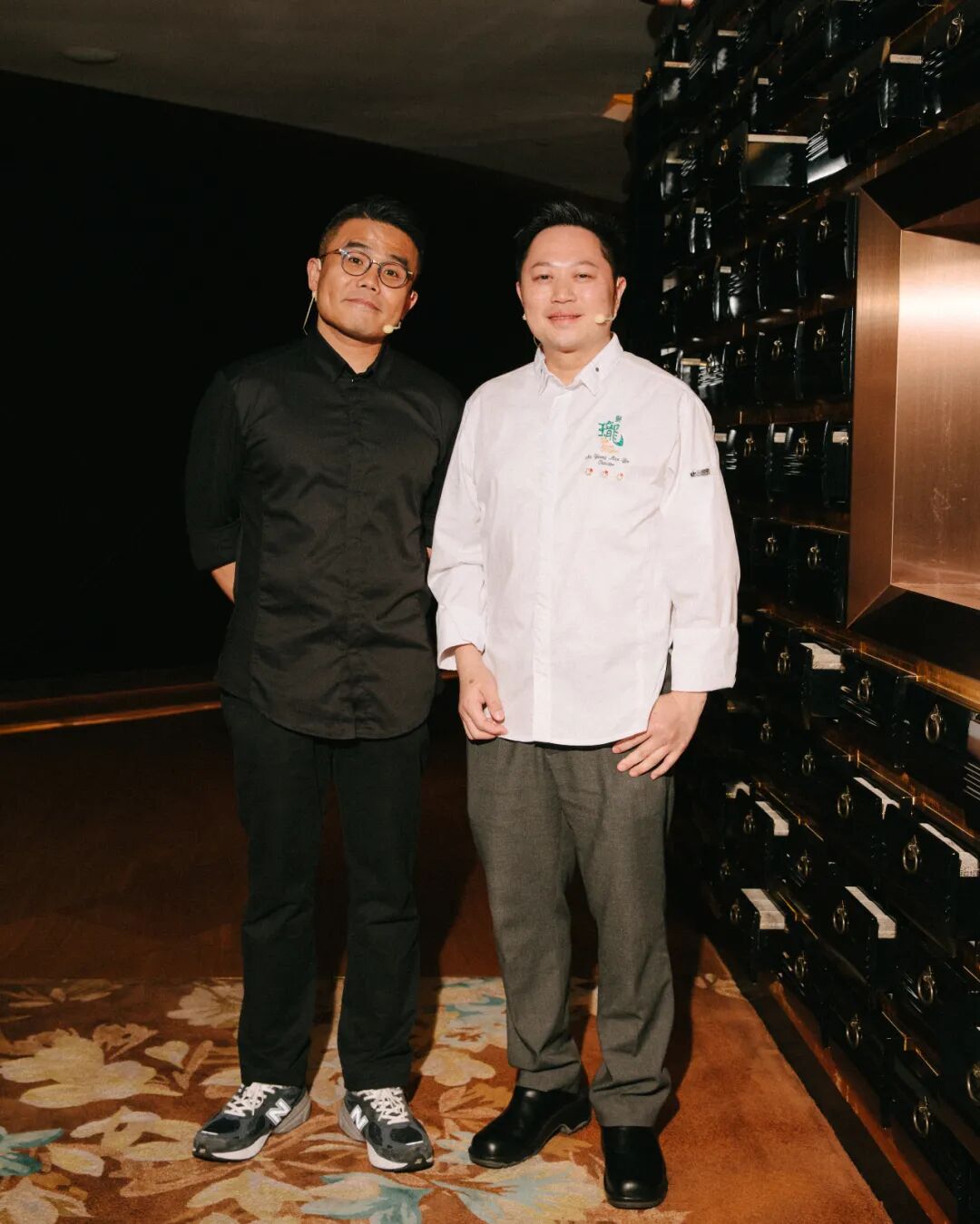 @City of Dreams
Cantonese and Teochew cuisine both fall under the same category,the languages are close, but the cooking logic differs.
Cantonese cooking chases wok hei (refer to the "breath of the wok") and freshness — high heat, fast stir-frying, forcing the life out of an ingredient. Teochew takes a different path: restrained, meticulous, built on the idea of "elevating humble ingredients through painstaking technique," letting the ingredient speak for itself. Braised dishes, clear-simmered soups, and clay-pot rice porridge form its backbone. Pairing fish with Puning bean sauce is non-negotiable, hard-wired into Chaoshan identity. And "da leng" — the cold late-night spread culture — is its most down-to-earth dish.Chao Shang Chao doesnot break this tradition — it builds on it, using precise heat control and exact ingredient standards to amplify the "depth" Teochew cuisine already has.
This was a lavish event — close to a hundred media and influencers from across Greater China were invited, with erhu and pipa performances, Dunhuang dance, and tea ceremony woven between courses. The menu itself said something about the spirit of this collaboration: no blurring of lines, every dish clearly attributed to its kitchen, yet together they read with a sense of rhythm.
The first bite — an amuse-bouche — works as Jade Dragon's self-introduction: their dim sum chops and ingredient choices on display in a single mouthful. A thin, glassy wrapper of wheat starch and tapioca starch holds a filling of crab meat, mixed with bamboopiths, water chestnut, carrot, and wood ear mushroom, topped with an edible flower that peeks through after steaming. Bite in, and the crab's sweetness mingles with truffle aroma, the water chestnut adding crunch — as pretty to look at as it is to eat.
The next course came in three parts: Chao Shang Chao's kinki fish rice tartlet, Jade Dragon's char siu with kumquat, and an oyster puff.
The kinki fish rice tartletis Chef Chueng's Chaoshan manifesto. "Fish rice" comes from the Chaoshan fishing tradition of eating fish instead of rice during long stretches at sea. The kinki fish used here is one of Japan's three great fish, rich and tender. Steamed, then chilled, the fish is paired with house-made lemon sabayon and a reimagined version of Puning bean sauce — the soul condiment of Chaoshan cooking — all assembled in a tart shell, layers distinct yet working together.
Char siu is never a small thing in Cantonese cooking. Chef Au Yeung uses the fatty Ibérico pork collar, cured the traditional way and slow-roasted over lychee wood — charred and fragrant outside, tender and juicy inside. On the side, a kumquat sauce cuts through the richness, and a hawthorn candy that looks like a miniature apple adds an childish playful touch.
The oyster puffis made with French Gillardeau oyster, deep-fried. I'm not usually a big fan of oysters — I would not say no, but would not seek it out either. This one had me nodding along. The pastry shell has a texture close to the radish strip pastries in Hong Kong-style dim sum: crisp, juicy, sweet and salty at once. With oyster as the filling, you get a briny depth and a firmer bite — a textural contrast against the pastry that made it even more likeable.
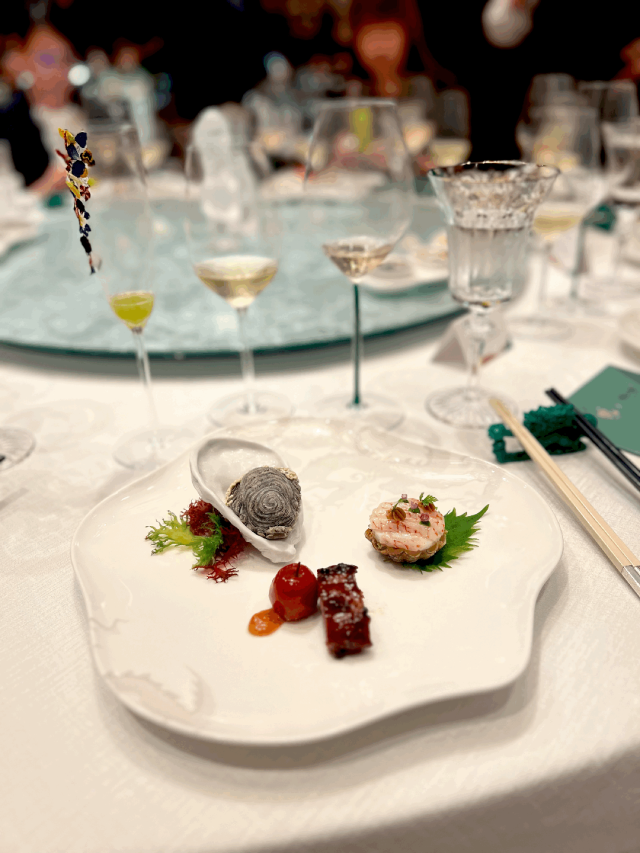 Chao Shang Chao's Kinki Fish Tartlet, Jade Dragon's BBQ Char Siu, and Oyster Puff
Next was "braised sea cucumber with aged preserved turnip" — Japanese sea cucumber paired with 25-year-old aged Chaoshan preserved radish. Liaoning sea cucumber is considered the king of sea cucumbers, eye-wateringly expensive, with a distinctive aroma and a slippery, chewy bite. Chef Chueng stuffed it with minced pork prepared in lion's-head-meatball style, adding another layer to every bite. The rice is seasoned with rice vinegar, bright and fruity against the rich sauce. My only complaint: not nearly enough vinegared rice to go with the sauce!
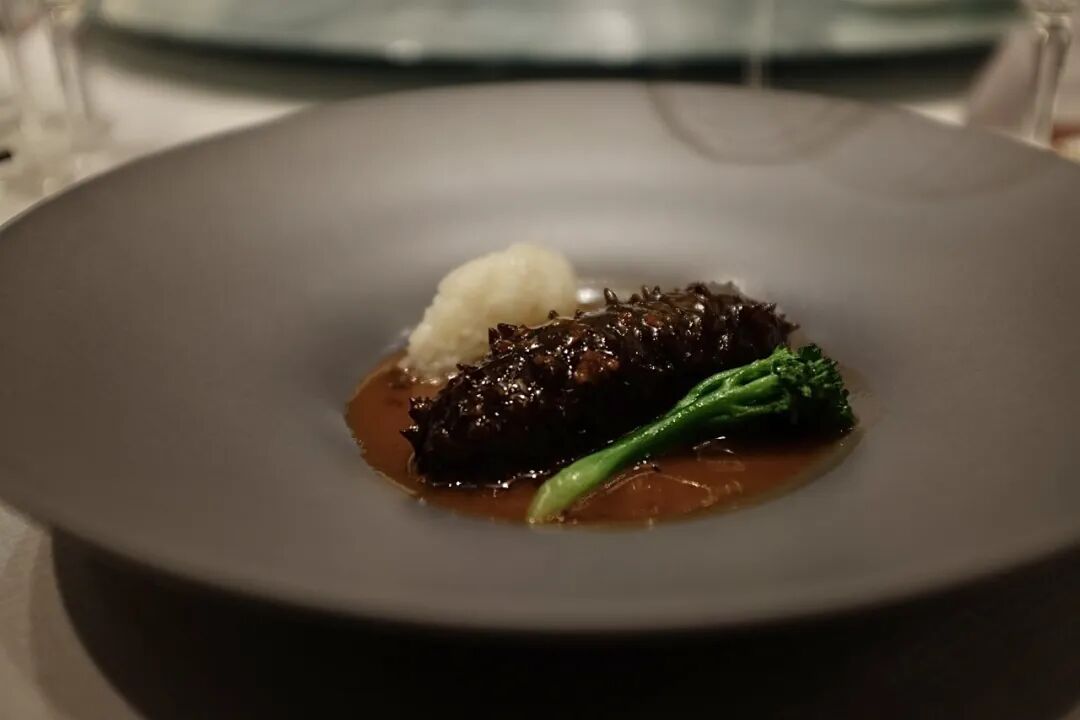 Chao Shang Chao's Braised Sea Cucumber with Aged Preserved Turnip
Guangdong's hot, humid climate tends to cause heatiness, which is why Cantonese cuisine generally leans light, letting ingredients speak for themselves. In the next abalone course, Chef Au Yeung went the opposite direction. The abalone itself was braised in stock until tender and juicy, the sauce lightly thickened, dense and umami-rich. Alongside it sat a deep-fried "lucky pouch" — built around the flavor profile of Sichuan's famous mapo tofu,to pair with the abalone. The faint numbing heat inside the pouch came through bean curd and minced meat, and combined with pickled radish on the plate, cut through the richness perfectly. Grafting Sichuan's mapo logic onto a Cantonese seafood framework sounds like a stretch, but it worked, somehow. This was my favorite dish of the night.
The centerpiece of the meal was a true joint work: deep-fried wild New Zealand cod-maw, crisp outside and gelatinous within, the collagen spreading through the mouth with a mochi-like stickiness; paired with French Brittany lobster wrapped in squash blossom into a pomegranate-shaped ball, served with a Hainan yellow chili sour broth that hit sour, fragrant, and spicy all at once. The fish maw's gelatin smoothed out the edges of that sour-spicy hit, the oil rounded out the flavors further, and a final touch of lemon leaf added another layer of aroma. The way the flavors and textures built on each other in the mouth was far more complex than the dish's simple appearance suggested — maybe this is where the two chefs' real depth shows.
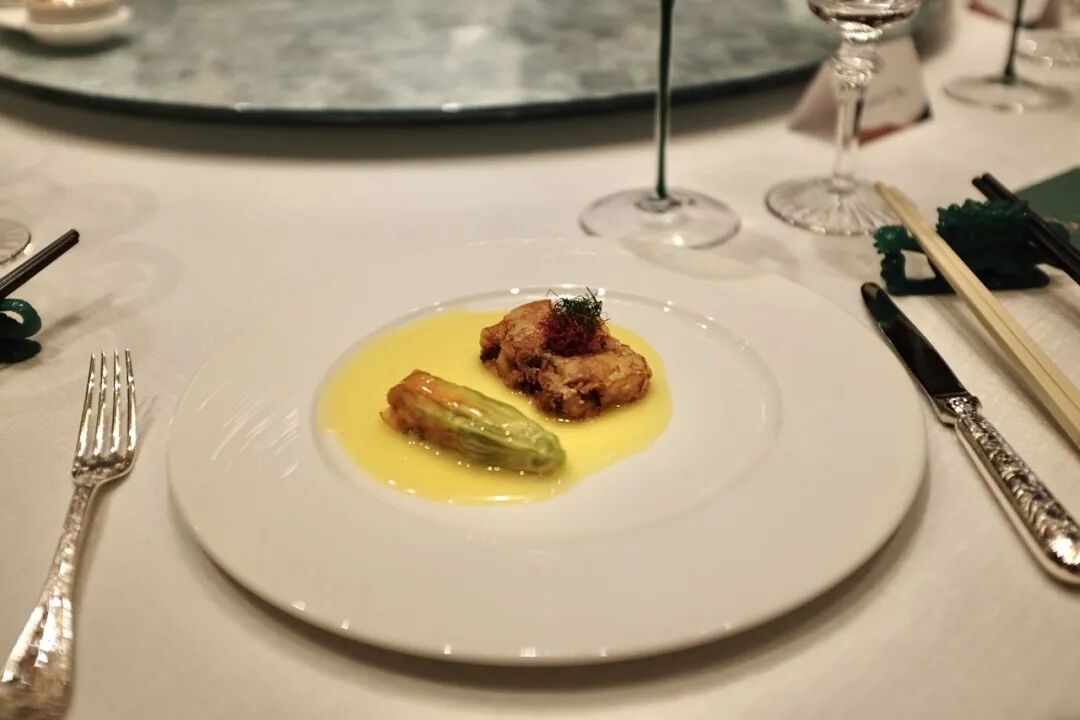 Chao Shang Chao × Jade Dragon's Brittany Lobster and Fred Cod Fish Maw
The final main course came from Chao Shang Chao: charcoal-grilled satay beef parcel, inspired by the Teochew home-style dish satay beef with Chinese broccoli. It takes one of the most everyday Chaoshan food memories and folds it into a fine-dining format, without losing its sense of familiarity. Dry-aged Australian wagyu, layered crosswise, with dried tomato and bamboo tucked inside, then charcoal-grilled as a whole. The heated wagyu fat paper merges with the charcoal aroma, served alongside sweet satay sauce and mustard seeds.
For dessert, the two chefs each got to show off on their own.
Jade Dragon's dessert tooks its inspiration from Macau's emblem flower, the lotus. Yam is shaped into a lotus flower, paired with a matcha jelly meant to evoke a lotus leaf, lotus seeds, and pickled lotus root slices. Underneath the "leaf" sit fermented rice sorbet and ginger foam, keeping the overall flavor lively.
Chao Shang Chao's scallion roll has something in common with the Taiwanese street snack peanut-ice-cream roll. A popiah wrapper holds peanut sugar powder, cilantro, and ice cream, all rolled up together. Chao Shang Chao's version adds candied apple cubes and jelly, giving it an extra layer of texture.
Cantonese and Teochew cuisine share roots, but they speak different languages. Making both languages legible in a single meal — and mutually intelligible — takes more than technique. It takes two chefs each confident enough in their own cuisine to know exactly where they can bend, and where they can't.
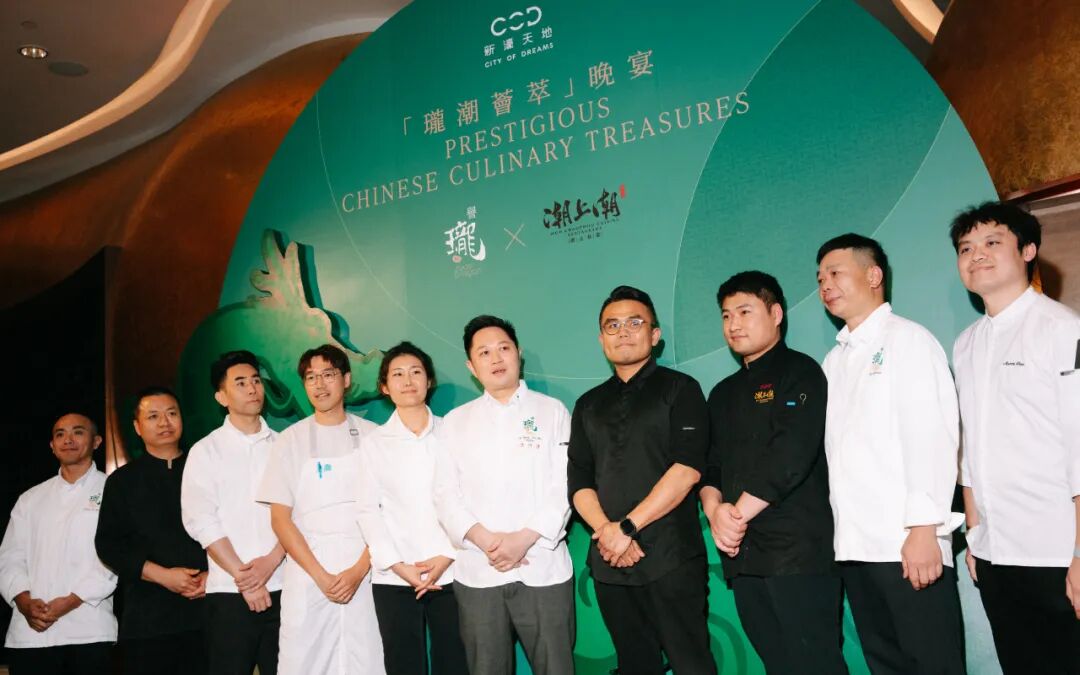 Jade Dragon and Chao Shang Chao Team @ City of Dreams
Text: Tina Hsieh
Photo credit: Tina Hsieh / City of Dreams